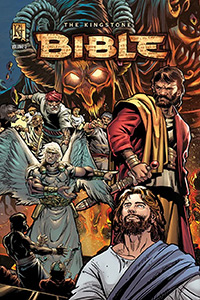
Several have asked and waited patiently for a review of this third and final volume of this iconic Bible comic series. And I agree. How could I review the first two volumes without completing the final installment of this series? Well, as you can see, I have not forgotten about this 704-page third volume; And I am so glad to finally complete this series. For too long, There was definitely an empty incomplete feeling of not finishing this series. Now I can share my final thoughts on the most complete graphic adaptation of the Bible.
Let’s start with its publishing page which states it is not a Word for Word adaptation. In the Publisher’s note, Art Ayris strongly encourages readers to read the actual Bible for themselves.
The third and final volume begins with Mary and Joseph heading to Bethlehem. As a child, several Christmas stories left out some interesting details. For one, I didn’t know Mary stayed with her cousin Elizabeth for three months. That explains how frustrated Joseph was about Mary’s pregnancy. Another detail left out was why Mary and Joseph travelled to Bethlehem to begin with. The actual reason was due to an ordered census by Roman officials that required everyone to return to their homeland. Bethlehem was Joseph’s homeland. On a side note, what is with this old man yelling at people to not take part in this census? That is not mentioned in the book of Luke at all.
Perhaps I was never told about the census because it was a boring detail that kids would not understand. But to me, it would have been great to know this because it then would explain why all the rooms were taken and there was no place for Mary and Joseph to stay. Here they are trying several places, which is not mentioned in the Bible. This detail does not bother me. It seems odd that Luke does not mention any details other than that Jesus was born in a manger. Was he born in a barn? A stable within a house? A cave? This volume shows a cave. Based on historical culture and context, the most probable area Jesus was born in would have been a room within a house where the owner kept their animals.
This volume also references Joseph looking for a midwife which is not mentioned in the Bible. Midwives did exist at that time, so while it is possible, it could have been possible Joseph was the one who delivered Jesus.
Let’s fast forward to Jesus as an adult, active in his ministry. Luke chapter 4 describes Jesus upsetting a crowd of Jews to the point that they wanted to drive him off a cliff. I always found this scene interesting because Luke says in a casual manner that Jesus passed right through them. How did Jesus pass through them? Did he disappear for a brief moment? Did he become transparent like a ghost? We don’t know exactly.
There are some moments I found quite humorous. There are several times when Jesus instructs people not to tell anyone about how he healed them. Here is one where Jesus says do not tell anyone, but off he goes running, and the narration says right away, “The man told everyone”. So not only did he not listen to Jesus, he went to the full extreme and told everyone! We see another one here; Jesus gives the same instruction, but both of these men go off and tell everyone. We even see a third example of Jesus restoring a man’s ability to hear and speak. He again instructs him not to speak, and of course, the man goes off and tells people. In fairness to this man, it would be so difficult for him to remain quiet when he has been in silence for so long. He must have been gushing out all kinds of words from his mouth to make up for so much time not being able to hear or speak.
Another humorous moment is when Peter says how Jesus told them to pray for workers for the harvest. The one disciple replies that their prayers have been answered. To which Peter replies “Yeah! Because WE are the workers!”
Then there are all the times Jesus makes the Pharisees look so stupid. Here we have one trying to rebuke Jesus for healing this woman on the Sabbath. Jesus tells him he is a hypocrite and asks him wouldn’t you free somebody from Satan regardless of what day it is? Which results in this hilarious stare-down where he is at a loss for words, and then walks away. He got schooled to which Jesus looked calm and continued with his teaching.
We see another example of this a few pages later where Jesus traps them in a question by asking “Is it lawful to heal on the Sabbath?”. They know that no matter how they answer, they are going to look foolish. So like the last Pharisee, they again have this blank stare in silence, to which Jesus right away continues to heal this man without being rebuked.
And it keeps continuing. Another Pharisee here accused Jesus of eating with sinners. When you take the time to think about it, it shows how stupid the accusation was. These Pharisees were so desperate in trying to catch Jesus doing something hypocritical. Yet it is Jesus who exposes them as the hypocrites. You can tell by their bitter faces how much their anger towards Jesus started to grow.
I am certain that the Pharisees wanted to murder Jesus more because he embarrassed them rather than because he claimed to be God. Being called a fool or a hypocrite and then embarrassed by not being able to answer Jesus’ brilliant questions would no question anger them. Not to mention their jealousy of the attention Jesus was getting.
Then there is the time a few of the disciples tell Jesus how beautiful the temple is. To which Jesus replies “Yeah, all that will be destroyed” and then walks away from them. The look on their faces is hilarious.
Then there are the moments that I either did not know about, or I was reminded of. For example, I did not know Mary Magdalene was demon-possessed.
I was reminded how Jesus found many opportunities to pray in solitude. Word was getting around fast about Jesus, and he was gaining popularity like a celebrity. Because of that, on top of being with his 12 disciples so often, Jesus was around people a lot. It was almost as if he was craving time to be alone with God the Father.
I forgot that Jesus too paid taxes. Even though he did not have to because well… he is the son of God, he did not want to cause any offense to the tax collectors. By not causing offense, Jesus did not want to give his enemies any ammunition or opportunity to find fault in him Jesus. I also forgot the incredible way Jesus did pay his taxes. He sent Peter to go catch a fish, and inside its mouth was a 4-Drachmas coin. As a kid, I thought Jesus had this secret bank account in the water. 2-Drachmas was the amount each person was to pay for taxes. So that four-Drachmas coin paid for both Peter and Jesus. It makes me wonder if the disciples knew about this. If they did, were they jealous that Jesus paid for Peter? In fairness, you could say Jesus sort of hired Peter to do a job and paid him for doing it. In that way, money was not given to Peter, but rather he earned it.
I also learned that Thomas to some degree was not doubtful, and had some amount of faith. When Jesus wanted to return to Judea to resurrect Lazarus from the dead, his disciples were concerned that Jesus might get stoned to death. They were trying to discourage or convince Jesus, not to go back. But then you have Thomas pipe up to the rest of the group and say “Jesus is going whether you like it or not. We should follow him regardless if we all die or not.” That to me was the bold faith Thomas displayed which is not mentioned enough. Too often Thomas is portrayed as this doubting character. This portrayal comes from his infamous moment of doubting Jesus’ resurrection. But here, he is not afraid of what may happen in Judea. He is bold and confident that no matter what happens, Jesus is with us.
I knew that Jesus caught his disciples sleeping the night of his betrayal, but I didn’t know he caught them three times. So many adaptations of the Easter story show Jesus only waking them up once. I can believe the reason for this was to get to the point and not waste time on a repetitive ordeal. But for me to know this detail now, makes me wonder how frustrated Jesus was because of this.
One thing that blew my mind which nobody seems to mention often, is how even in Jesus’ death, he still raised people back to life. Several tombs busted open and they went into the Holy City and appeared to many people. I had no idea this happened. To me, this detail is not mentioned enough because Matthew is the only gospel that records this. Mark, Luke, and John did not mention this. Most of the gospels focused on the thick temple curtain being torn, which don’t get me wrong, was also a big deal too. But to see “many” people come back to life…that was an incredible new detail to learn about.
Now let’s take a look at some other things I noticed.
I always found it weird how Jesus asks two of his disciples to just flat out take this donkey and colt from a man’s house. You would think that Jesus would tell his disciples to ask permission from the man first. This scene is a bit odd to me because It’s not an issue of Jesus not having the authority to do so. If he wants these animals, he will take them. It’s more an issue of why didn’t Jesus instruct them to ask the man first and explain why rather than taking them first and then explaining once confronted.
This is especially true later on when it comes to preparing the last supper. Jesus tells Peter and John to tell the man carrying a jar of water that “Jesus asks to use your guest room.” It sounds more like a command than an ask, but at least there was some sort of discussion and notice given beforehand.
When it came to the “Parable of the Tenants” I never liked the logic used in one specific part. This is where the owner of a vineyard sends servant after servant to collect a harvest, and each one is beaten by its farmers. As a last resort, the owner sends his son who was then murdered. The owner uses terrible logic here. If I was an owner, I would right away find out why the first servant was beaten rather than sending all these servants and then even my own son. I know this parable is meant to share a greater message of grace and several warnings to wicked people. Even though the logic is questionable, I have to remember that this is a direct metaphor for what God has been enduring with us. Sending messenger after messenger, before sending his son only for him to be killed. This shows the immense amount of patience God has for us which is far above our logic.
Volume Three is not without some minor mistakes. First, we have Jesus outside telling people to not, “let the Hypocrisy of the Pharisees get into you, too!”. But then on the next page, he says the exact same sentence word for word. I first thought Jesus was repeating himself on purpose to drive the point home. But nowhere in Luke chapters 11 or 12 have Jesus repeating that warning twice. Kingstone could say this is their use of artistic liberty, but I kind of think it is a printing error.
Regardless, it is not a major mistake like having a spelling error here. Jesus is trying to say that his disciples will “hear of wars and rumors of wars.” but the word “of” is spelled as “or”. After checking a few translations of the Bible, each of them has Jesus recorded as saying “You will hear OF wars” so this is definitely a spelling mistake.
Or how about this grammatical error where Paul writes “grace has been give just as Christ decided to give it…” The word “given” is missing the letter “n”. This was checked in Ephesians 4:7 and it does use the correct word “given”; Not “give”.
The last mistake I noticed was also a grammatical one where Peter escapes prison and is knocking at the door. The disciples are not sure if it is him. Despite the fact they hear his voice, one of them then says “Then it is must be his angel”. Having the word “IS” added makes this sentence disjointed. Again after checking a few translations, as expected the word “Is” was not added. So there you have it, a small grammatical error.
Here is something that was rarely used for the entire three-volume series. This is a rare panel that displays a cool depth-of-field effect with a few of the disciples blurred in the background. It is too bad they did not use this effect more often because it adds a layer of dramatic effect.
Now we are at the last Supper and I never liked the part where none of the disciples ever rebuked Judas while he left the table to go and betray Jesus. Everyone at that table should have been able to figure out that the betrayer was Judas. Yes, I understand that this event needed to happen, and it was going to happen anyway. But I never liked that not one of them spoke up against him as he walked out to literally sell out Jesus. Their teacher was about to be betrayed right before their eyes. Even if I grant that they didn’t know who the betrayer was, Jesus did tell Peter who it was. So how could Peter sit there and not at least rebuke Judas as he was walking out? I know it wouldn’t have changed the outcome, but it would have shown some integrity in calling out the wrongdoing of a person.
When Judas committed suicide, the disciples needed to find someone to replace him. I never liked the idea of the disciples throwing dice to determine who should replace Judas. While Mattias ended up being Judas’ replacement, it feels weird how he was picked. It looks like their decision was based on the result of dice being thrown. It seems out of place considering they recently received the Holy Spirit from Jesus. The Holy Spirit could have provided the disciple’s guidance, counsel, and wisdom.
Then there is some major creative liberty here as Saul of Tarsus is arguing with Nicodemus to the point that he shoves him to the ground. There is no scripture reference to this interaction at all. I could not find any mention of that in the Bible. So that is an addition to add some dramatic effect. But additions like that could also confuse readers into thinking Saul had a physical altercation with Nicodemus.
It’s so weird how Luke mentions this miracle Paul performs casually. It happens in Acts 20 when Paul is at a home in Troas teaching the scriptures late in the evening. A young boy named Eutychus falls asleep at the window and falls to his death. In one quick sentence, Paul goes downstairs and with the power of the Holy Spirit, brings Eutychus back to life. Paul then goes back to teaching like nothing major happened. But I love what appears to be dry witty humor when the added sentence reads “No one sat by the window”. Almost makes you wish Luke wrote that.
If there existed only one autobiography book from one character of the Bible that I would love to read, it would be of Paul. It is so crazy how this man escaped death time after time. From escaping jail to being temporarily blind, to all his travels where he started churches and performed miracles. The man had such a turbulent and tumultuous life. He survived deadly whippings, stonings, and even a shipwreck at sea. There would be so much for him to share. One story I would love for him to talk about is when he was being tried as a criminal for his blasphemous teaching of Jesus. He was to have a trial before Ceasar, but he had to travel from Caesarea to Rome for that trial. So soldiers detained Paul the entire time as they all travelled to Rome. They boarded a boat and traveled at sea. The problem was that traveling by boat during the winter season was dangerous. Paul warned the captain to halt travel, but he didn’t listen. Even when Paul ends up being right, he tries to still help and give advice. They end up shipwrecked on the Island of Malta where a poisonous deadly snake bites Paul. He whips the snake into the fire, yet doesn’t die at all. Later on, they all have dinner with a wealthy Maltan who requests Paul to heal his father from an illness. Paul not only heals that father but many more people all over Malta. Then when they all finally arrived at Rome, so many of Paul’s followers welcomed him home. For these guards to witness all these things would have to give them second thoughts. They would have to realize the strong possibility that everything Paul spoke about Jesus could be true. That kind of sequence of events would have been so awesome to hear from Paul’s perspective.
As I have mentioned before, a large and mighty team of artists contributing to these volumes will result in the art style changing. You will notice certain characters will look very different from before. Jesus is the one character whose appearance will most often change and look different. You will still know it is Jesus, but you will see the difference in his appearance throughout the pages.
Along with the reminders and retellings of Jesus’ death, you will also see different visuals and perspectives of him on the cross.
Because this last volume deals only with the New Testament, you will see the book of James in a unique way. You will see pictures of our current world and how James’ teachings apply to us today (526-530). I don’t believe these types of images appear in any of the other volumes.
Then there is the final book of the Bible, Revelation. I want to start by saying it was a foolish decision for Emperor Domitian to exile John rather than murder him. I know Christianity would have still spread regardless. But if I was that emperor, murdering John would have been the best way to silence him rather than letting him live on an island. To keep him alive still allowed John to reach people through his letters; which as we all know still do to this day. Had they murdered him, that would have eliminated his voice and those letters may have never existed.
I have often said that the visuals Kingstone provides are stunning. But when it comes to the book of Revelation itself, they saved their absolute best work for last. I can’t tell you have amazing, stunning, disturbing, and breathtaking these visuals are. They do an incredible job of bringing to life the dreams John visualizes. There are so many dual-page spreads that allow the reader to immerse themself in. Revelation is one of the most difficult books to understand, which is why I appreciate the bottom footnotes. It gives context to many of its verses to help readers understand what is going on. It still won’t explain everything, but at least it will not leave readers confused or in the dark. I know the creation story in Genesis has amazing visuals, but if you want to see the absolute best, read the entire book of Revelation in volume three. They end this final volume with their best work.
As I give my final thoughts on this series, there is not much for me to say. These three volumes still reign supreme as the most comprehensive comic Bible out there. The only one that could challenge them is the Word For Word Bible Comic series which they are still working away at. Having said that, Kingstone is already an established brand. They have a large team that continues to publish incredible works.
Creative liberty will always be the heart of the issue with these comics, which will always be a valid concern. I will say this. After reading all three volumes, I actually enjoyed going straight to the Bible to challenge their creative liberties. I did find errors. I did find mistakes. This is exactly why Kingstone encourages us to read the Bible for ourselves to begin with. They make mistakes in their work, and they know that. But if somehow their work brings people closer to Jesus, it is all worth it for them.
There will always be other options out there that share the Bible in comic format. But It will be very difficult to dethrone Kingstone as the king of comics.