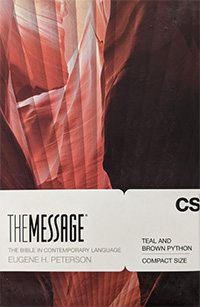
The Message by Eugene Peterson, is the Bible in contemporary language. I know what some of you are probably thinking already: am I trying to endorse The Message? I definitely am not going to be endorsing it. Instead, I just want to share my experience with The Message, what this book has meant to me throughout the years, and let you draw your own conclusions.
Right off the get-go, I would not endorse The Message overall as an official translation. I don’t believe it is one. I know you can go to Bible.com or BibleGateway.com and find it listed under their translations, so it is widely viewed as one, but I would say it officially is not. Paraphrased is probably a better way of putting it; it is basically Eugene Peterson’s rendering of the Bible. His goal was to make the Bible come alive. I don’t fully agree with that assessment because the Bible is already alive and active, sharper than a double-edged sword, but I get what he was trying to do. He was trying to provide contemporary language to help people understand difficult verses.
When I first came across The Message, I was quite impressed with the wording. I was struggling to understand many parts of the Bible, and coming across this type of text really helped me with a lot of difficult passages. Now, the ESV (English Standard Version) is my favorite translation, and it is quite accessible. Even with the ESV, there are a few verses from time to time that I struggle with, and sometimes I still cross-reference The Message to get a different wording of that scripture. It has helped me many times in the past.
Personal Experiences and Bible Study Hurdles
I purchased this particular copy back in 2005. This is the “Numbered Edition,” so it is quite an old book. I don’t read from it much anymore, but when I first got it, it was a very helpful companion.
It was actually quite funny because I brought this book to one of the first-ever Bible studies my friends invited me to. We were going around in a circle to read particular passages, and when it came to my turn, I read from this book. Everyone in the group gave me a really weird look because they were all reading from the NLT, NIV, or KJV. I was the only one with The Message because I truly believed it was an official translation at the time. That moment gave me the insight that this is definitely a very different type of book. As I began diving into the scriptures more, I came to realize that while The Message is great, you are not going to get much from it in terms of deeply studying the context.
The Challenge of Verse Numbering
This specific version has verse numbers, which I appreciate because the earliest editions didn’t have any at all. Some people loved that original design because it read more like a novel, which was a huge selling point, but it made cross-referencing incredibly difficult when you wanted to look up an exact verse.
While it is nice that this edition includes verse numbers, it unfortunately does not list them verse-by-verse. Instead of singular verses, it groups them into chunks and sections, such as verses 17 to 19. If you want to look for verse 18 specifically, it is nowhere to be found. Another massive chunk spans verses 9 to 14, making it hard to find out exactly where verse 11 or 12 sits. If you want to look up a highly specific verse, this formatting style is a major downside and a stumbling block for deep study.
Evaluating Famous Passages: John 3:16
Let’s look at John 3:16, the most popular verse in the Bible, to see how it reads:
“This is how much God loved the world: He gave his son, his one and only son. And this is why: so that no one need be destroyed; by believing in him, anyone can have a whole and lasting life.”
That is a pretty cool perspective on that verse. It gives a unique take on it, which reflects what Eugene Peterson meant by making the verses come alive. But again, we fall into the problem of the verse numbers. This section is labeled as verses 16 to 18, so you don’t know exactly where individual sentences start or end. During my Bible study days, if someone asked me to read John 3:16-17, I wouldn’t know where verse 17 ended, which was another struggle I faced.
Final Verdict: Training Wheels for the Bible
The particular copy I have here is pretty bare-bones; there are not many bells and whistles. There are no red letters when Jesus speaks in the Gospels, and there are no maps. At the very end, the only extra feature is a section titled “The Story of the Bible in Five Acts”—there isn’t even a concordance. It is just a very compact edition.
Ultimately, The Message is a fantastic resource to use for occasional cross-referencing. However, we now live in a time where it is so easy to just go to Bible Gateway or use Bible software websites to cross-reference multiple versions instantly. Because of that digital accessibility, buying a physical copy of The Message is becoming almost unnecessary.
I would definitely not treat this book as a source for accurate theology. If you really want to study the Bible, this is not the version you want at all. It acts as a set of training wheels in some regards, but there are so many translations out there—like the NLT—where you could do just fine instead. I would not recommend buying The Message, and I don’t endorse it as an actual translation. It certainly helped me in those earlier years of learning, so it holds a special place in my heart, but once you leave The Message behind, a whole new world of understanding the Bible opens up.