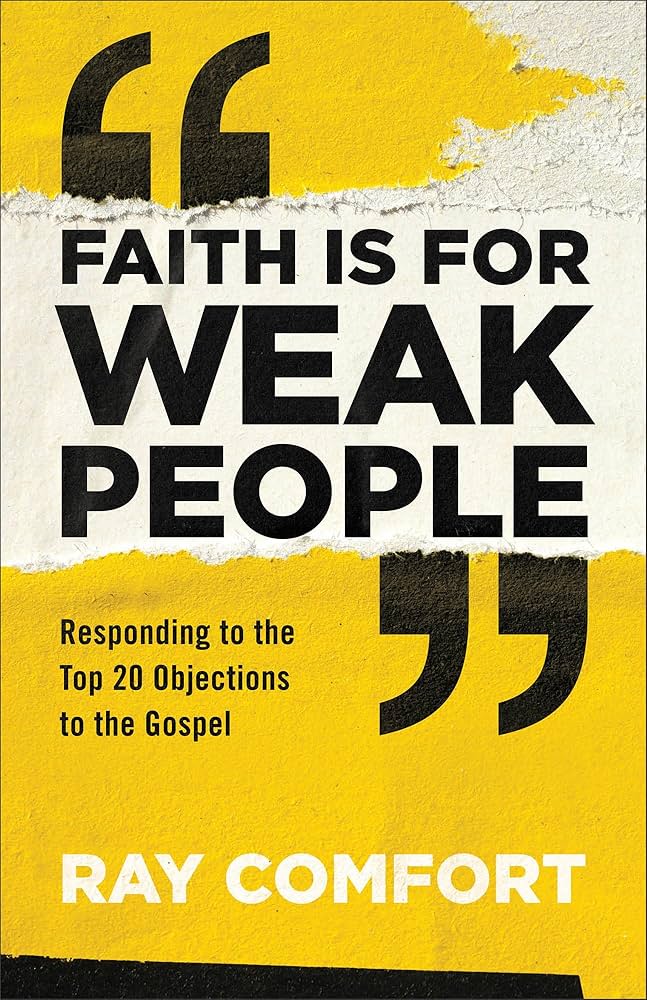
You have likely seen his videos on YouTube. Ray Comfort, the founder and CEO of Living Waters has hundreds of videos having conversations with atheists and those of other religious beliefs. Although his videos are heavily edited, he appears to at least get people thinking and sometimes have them converted to Christianity right on the spot. Comfort admits that it can be scary to have those conversations, but in his book “Faith is for Weak People” he shares a simple strategy along with addressing the top 20 objections to the Gospel.
For the sake of not repeating myself, many of these objections are similarly addressed by Rebecca McLaughlin’s “Confronting Christianity” book which I reviewed. So instead, I will examine half of these objections that were never addressed before.
In the introductory chapters, it does not take long for me to disagree with Comfort. On page 22, he shares how our conscience should be like a smoke detector that goes off if we are doing something morally wrong. That I agree with. But he then goes on to say that, “It’s morally wrong to busy ourselves with other things while anyone goes to hell” and that if he were to “walk past any human being without concern for their salvation, an alarm bell goes off.”
It seems a bit disingenuous to claim that it is “morally wrong” for people who are busy with things while any human being goes to hell. People can be busy for all types of good reasons, even God honouring ones. Also, this statement seems to convey that Comfort knows which people are supposedly going to Hell. That is not for him to make that claim. Unless he is suggesting that if people are certain that a person is lost, but purposefully busy themselves to avoid warning them about their salvation, then I can agree with that being morally wrong. But the way he words that statement is way off base.
While this early disagreement appears as though I am going to disagree with much of what Comfort says, that is not the case. I find that he has a different way of evangelizing. He is not wrong, but it is not for everyone. Comfort loves apologetics, but his style and strategy is going to be different from other apologists. Some apologists like to convince skeptics about how for example it is possible for an ark to be built, or to survive in a whale for three days. Comfort on the other hand doesn’t want to just defend the faith, he wants to advance it. To him, apologetics is not only about explaining how the Bible is credible, it is about sharing the Gospel. So how does he do that?
Well, Comfort gives the analogy of how even though David battled Goliath by grabbing five stones, he needed a sling to aim and launch those stones. To evangelize and share the gospel to strangers without offending them can be like battling a Goliath for many. Even Comfort admits he still has those fears. But the sling we can equip ourselves with is the Ten Commandments. This has been Comfort’s sling for many years. There are three key questions he discovered that inoffensively opens the conversation about God, and helps him deal with his fears. The first question is, “Do you think there is an afterlife”. It is an instant mountain mover in being able to initiate a conversation about God without even having to mention anything controversial or offensive. He then follows up with “Do you think you’re a good person?” and “Are you afraid of dying?” Comfort also uses these three questions to help him determine who is humble. Whether the person is humble or prideful, it gives Comfort a barometer of whether he should continue the conversation or not. A prideful person will usually not be willing to listen, to which Comfort will move on. But a more humble person that answers those questions, allows Comfort the opportunity to use the ten commandments as his sling to launch the gospel message.
Comfort believes that it is more important to convince the world with the heart of the Gospel, rather than our intellect of scripture. Now of course he is not dismissing the reliability of scripture. Comfort believes trying to prove the Bible is putting the cart before the horse. You could be an expert with a sword, but to Comfort, it is useless compared to a speeding bullet. He believes the Ten Commandments are like 10 cannons that can immediately shoot down a stronghold.
It’s a great analogy, but it overshadows the biblical analogy of the armour of God because ironically it is the sword of the spirit which is God’s word. Of course, Comfort is making his analogy more relatable for today by referencing a gun as there were no guns in the first century.
So let’s take a look at 10 of these 20 objections.
If God is supposed to be in control, why does it seem so out of control?
I disagree with Confort when he says, “The world is out of control in every area”.
He points to all the terrible things going on in the world. The world has never been “out of control”, but aside from the Garden of Eden, it has been broken. I do agree with Confort, that Satan is the god of this world. So whether some believe it is God or Satan, the world is in control; it’s just broken.
Even then, God is still ultimately in control of this current world. Of course God will create a new world that will never be broken. But to say that this world is out of control would mean nobody is watching over it, which is simply not true.
What sort of God would threaten to torture people in hell forever just because they don’t believe in Him?
I don’t think this is a legitimate question. I have learned that sometimes the question needs to be questioned itself. Comfort also points out that the question is a straw man argument. Where in scripture does it say God would torture people in Hell? Hell is a place of eternal separation from God. It is not possible to be tortured by God when you are separated from Him. But the bigger issue with this question is the idea that a loving just God would even torture people to begin with.. Yes, God warns of Hell, and that it is a terrible place to spend eternity. But that is the free choice for people who don’t want to be with God.
Comfort believes that the lost are not being reached because two necessary elements are being left out of the modern gospel. First is the nature of sin, and the second is the future punishment as a result of that nature of sin.
Isn’t the God of the Old Testament different from the God of the New Testament?
Skeptics tend to think that God was more harsh in the Old Testament, and much more forgiving in the New Testament because of what they read about Jesus. But if anyone reads the book of Revelation, it does not take long to realize that God is still the same. He is still just and will punish the wicked. Hebrews 13:8 makes it clear that “Jesus Christ is the same yesterday and today and forever.” (ESV). In Malachi 3:6 God says that “For I the Lord do not change; therefore you, O children of Jacob, are not consumed.” (ESV)
Would you sacrifice your child if God asked you to?
This objection is based on the story of Abraham when God told him to sacrifice his only child. This was during the old covenant where animal sacrifices were a way to atone for sin. God eventually stopped Abraham from sacrificing his child as it was a test to see if Abraham would trust him. God would never demand that type of sacrifice today, because the new covenant is Jesus being the ultimate sacrifice for past, present and future sins (Romans 5:8). The only sacrifice God demands is our own bodies as a living sacrifice (Romans 12:1). Also, I do not recall God needing to “ask” for anything. He asks questions that he already knows the answers to. But he doesn’t ask us to do something. He tells us to do it, and we either obey or disobey Him.
Why are there so many hypocrites in the church?
Everyone is a hypocrite, but if this question is coming from a place of holding Christians to a higher standard, well even Jesus said that those who point a finger at the hypocrite will be judged by the same standard by which they judge others (Matt 7:2). Even if Christians are held to a higher standard, everyone is going to have to give an account of themselves, not others. The hypocrisy of Jesus’ messengers does not invalidate the reliability of Jesus’ message. So it’s not worth focusing on someone else’s hypocrisy when really we should be focused on our own.
You can’t prove God exists; even if you could, if everything needs a cause, what god made God?
Correct. God’s existence can not be proven. Comfort thinks, “there is ample proof for the existence of God” which I kind of disagree with. I believe there is ample evidence. Proof and evidence are two different things. Proof is more about facts and evidence is more about information. Proof requires evidence. If I gather enough evidence in a court case, when it is all combined, it could be enough to prove my case, but not all evidence constitutes as proof. When it comes to the existence of God, it is not possible for me alone to prove that. But there is ample evidence to show that God’s existence is highly reasonable and likely.
As for who made God, The key words in the cosmological argument is that everything that began to exist. God does not fit in that category because God never began to exist. He has always existed. He is the uncaused cause. Because He is eternal, He is outside of time, and therefore never had a beginning. This is sort of an important prerequisite for a god to be a God.
Unbelievers are as good as any Christian, if not better, so why aren’t we good enough to get into Heaven?
Nobody is good. We are all sinners. I also don’t think it is helpful for this objection to speak in generalities. Yes, there are some unbelievers that are more kind and generous than Christians. Yes, there are some Christians that are more kind and generous than unbelievers. Because of who God is, Christians are held to a higher standard than unbelievers, but that doesn’t make them better. As Comfort wisely says, “Christians are not better than non-christians; they are just better off”
Comfort uses the parachute example of how just because one person has a parachute, does not mean he is a better person than the one without it. The one with the parachute is just better off. That is the same thing with those who have Jesus compared to those that do not.
1 John 5:12 emphasizes this by stating “Whoever has the Son has life; whoever does not have the Son of God does not have life.” (NIV)
Comfort adds context to this by stating, “We don’t live a good life to be saved, but we live a good life because we are saved.”
What happens to those who have never heard the gospel?
It is pretty safe to say that everyone knows that someone, or something is responsible for all the order and design in the world and the universe. How that someone or something is identified is different.
Theists identify that person as “God”. Everyone else has their own term or name. Regardless, most people know that the universe didn’t just pop into existence. Everyone also has to wrestle with the purpose of their life. In this age of the internet, nearly everyone has come to understand the basic message of the gospel. For those few that have not, I am certain that since God is just, nobody will be condemned to Hell without having the opportunity to hear the Gospel and to either accept or reject it.
Now Comfort would probably disagree with my take on that as he adopts a more black and white approach when he says “The reality is everyone will be held accountable before God, whether or not they have understood the gospel.”. But that doesn’t really answer the question as to “what happens”.
Personally, I don’t know what will actually happen, but because God is just, everyone will be judged fairly including the very few that somehow have never heard of the gospel.
Seeing is believing. Why do I need faith? Faith is for weak people.
This is already a ridiculous question for at least a couple reasons. First if seeing really was believing, so much of history would be wiped out because we never saw it with our own eyes. Especially in this video saturated culture, many think “If it was not captured on video, we can’t believe it happened.”
The other reason this is ridiculous is because of that last statement which is aptly the title of this book, “Faith is for Weak People”. Everyone uses faith every day to some degree. Whether it is taking a flight not knowing who the pilot is, or driving through a green light without looking both ways first. Everyone uses faith. I think skeptics hate the word faith and are trying to replace it with more secular terms like “trust” or “evidence”. The problem is that these terms are derived from faith. Faith is based on evidence and it needs to come first before trust actually happens.
Some questions are not worth addressing because sometimes how the question is asked is not coming from a heart that is seeking truth. God resists the proud and gives grace to the humble.
I can murder a hundred people, then give my heart to Jesus and go to Heaven?
I almost have to defer to my previous statement as the question does not appear to come from a heart that is seeking truth. Yes, God’s mercy is endless, and theoretically one could murder a hundred people, and because assuming that person confessed their sins, repented, and gave their life to Jesus, God’s grace is sufficient enough to save that person.
But if that person is wondering how far they can push the boundaries of God’s mercy without crossing it, that person is missing the point of a committed relationship with Jesus. That would be like a man asking if he can sleep with a hundred women, then give his heart to one woman and get married. If there is no true confession of their sins and willingness to repent, there is no evidence that the person has remorse and is committed to turning from their sinful ways.
Comfort shares an overwhelming amount of scripture that emphasizes the importance of repentance.
Whether one is a murderer or an adulterer, they are both saved by Grace and Grace alone. Grace however is not a license to sin. Confessing and Repenting of sin is a true sign of sorrow and transformation towards receiving God’s grace. Just believing in Jesus is not enough.
“Faith is for Weak People” by Ray Comfort provides a unique strategy for Christians to share their faith in an inoffensive way. While I like the three questions he asks, his overall style and method will not be for everyone. It’s not wrong, but I prefer to develop a relationship with the people in my life before I have those conversations. To approach strangers and immediately ask those questions, even as innocent as they are, still come across like a salesman trying to sell you something. And while the Gospel is free and amazing and should be promoted, it doesn’t need to be promoted as a “please accept it” but rather “it speaks for itself”.
Lastly, for those that just want quick straight answers to these objections, I found a pattern in this book where if you just go to the last one or two paragraphs of the chapter, you will get a more concise and direct answer. Everything else Comfort writes about are stories and examples to help illustrate his answers.