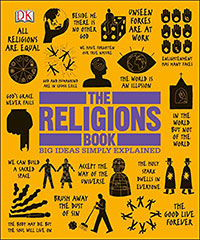
Not too long ago, I took a hands-on, inside look at The Bible Book from DK Publishers. I was thoroughly impressed with it—so much so that I decided to buy another very similar, yet different volume: The Religions Book. As you would expect right off the title, this one dives into as many of the religions of the world as possible. Because I was so thoroughly impressed with the first one, I decided to buy this to complement The Bible Book a little bit.
This volume is part of their “Big Ideas Simply Explained” series. That is exactly what they try to do across all of the topics they discover: taking big ideas and explaining them simply. I think that is what we all want to see in a book, especially if we are trying to learn something as complex as religion, because there are just so many out there.
This softcover version features a bright yellow cover with purple accents. It retails for $18 American or $23 Canadian, which is a bit cheaper likely due to the paperback format.
Collaborative Team and Content Directory
Let’s just jump right away into this one. It features another team of contributors, and rightfully so. I think you absolutely need a team like this when exploring the religions of the world.
The contents page follows basically the exact same format as The Bible Book. It covers:
Primal beliefs from prehistory
Ancient and classical beliefs
Hinduism
Buddhism
Judaism
Christianity
Islam
Modern religions
When looking through the modern religions section, I noticed that Sikhism is tucked away on page 296 under “The Sikh Code of Conduct.” I also noticed that Mormonism and Jehovah’s Witnesses are not main focal points, but they are included under that modern religions umbrella as well. I am glad that they essentially touch on everything, or as much as they possibly can, in a book that clocks in at about 351 pages.
The Value of Exploring Other Faiths in Apologetics
Clearly, they are going to stick with the same format and layout as The Bible Book, and I am very impressed right away with what I am seeing here. There is just so much great content. I would love to read this because I want to explore other religions of the world.
A lot of times, especially in the realm of apologetics, we ought to know other religions and what they believe. Ultimately, it is most important to know your own faith very well—that is crucial to apologetics—but I think another key element is understanding other people’s faiths, beliefs, and religions that don’t line up with yours. That is important, especially for a seeker or a skeptic, because this will really help them understand why people across the world believe what they believe. From there, I think it’s great because they can draw their own conclusion about what religion or faith actually makes the most sense to them.
It is great to know your own faith, but I think this will be a fantastic book for any aspiring apologist to study some of the other key faiths. In some ways, you almost need to, especially if you are going to dialogue. Let’s say if you dialogue with a Muslim, you want to learn about Islam, Muhammad, Allah, and the Quran.
Simplifying the Trinity and Complex Concepts
Looking at the Christianity section, they have a page titled “God is three and God is one.” Let’s see what they have to say about the Trinity here, because a lot of people—even Christians—get tripped up on the Trinity and what it is. The text states:
“There is only one God, but Christians experience God in three ways: God the Father of Jesus, who sent him to the world that he had created; Jesus the Son of God, who came to the world to bring God’s kingdom; and the Holy Spirit, who is with Christians now that Jesus has returned to his father. These three are completely united in what they do, even though each one has a particular role.”
Personally, I don’t know if I would say “God in three ways.” I think I get what they are saying, but I would instead say “God in three persons that are co-equal and co-eternal.”
The book notes that in a math test, it is safe to assume that 1 + 1 + 1 = 3, but that is not so in a theology exam—which is rightfully true. I think a better way of doing the equation to simplify it in its simplest terms is 1 × 1 × 1 = 1: one God, three persons. It is so hard to wrap your head around that.
They include visual diagrams to help, which I think are pretty useful. It shows the Father, the Son, and the Holy Spirit as distinct persons—the Father is not the Son, the Son is not the Holy Spirit, and the Holy Spirit is not the Father—but the Son is God, the Father is God, and the Holy Spirit is God. When you see diagrams like this, these are the kind of things that make this book shine because it helps simplify a very complex term. That completely fulfills the whole point of the book: big ideas simply explained.
Deep Dive into Islam and Final Thoughts
Moving on, we find the section on Islam. This would be something I would love to explore. Islam is one of the fastest-growing—I think it actually is the fastest-growing—religion in the world, so it is best for any apologist to learn about it. Learning about the Five Pillars of Islam is definitely something worth doing.
The book covers concepts like the Shahada, the Salah, the rights of Mecca, lightening the burden, and the pilgrimage to Mecca. These are all common terminologies that I don’t personally understand very well yet, so seeing such a great, thorough look at Islam is fantastic.
They basically took the exact template of The Bible Book and corresponded it directly with the religions of the world. I can’t wait to dive into these pages; I just want to bury myself and read books like this. There is so much edification here. Could you just go on the internet, click on websites, and watch videos instead? Absolutely, you can. But it is so refreshing to see physical books like these with pictures. I just don’t think there is any other immersive experience quite like reading a book like this one.