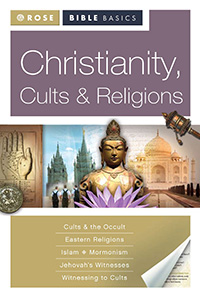
I don’t know what to expect from this book other than what the title says, but we have the subtitle here: “Cults and the Occult, Eastern Religions, Islam, Mormonism, Jehovah’s Witnesses, Witnessing to Cults.” This will clearly be an informative book that takes a look at a lot of the main faiths and religions of the world. It is a pretty thin book, so I’m not sure how much they’re going to really explore, but let’s take a look inside.
The pages have a nice matte feel to them. This one is fairly old, published in 2008 by Bristol Works, which is a publishing company I’ve never heard of before.
Chapter Breakdown and Formatting
We have our contents page here:
Chapter 1: Christianity, Cults and Religions
Chapter 2: The Christian Cults and the Occult
Chapter 3: Christian and Eastern Religions
Chapter 4: Islam and Christianity
Chapter 5: 10 Q&A on Jehovah’s Witnesses
Chapter 6: 10 Q&A on Mormonism
Chapter 7: 10 Keys to Witnessing to Cults
There is a lot of comparison going on between Christianity and everything else. They have a lot to cover. These pages are filled with pure text, but they do have a little bit of formatting and tables here. I’m not sure if I like how much is crammed in here, but it works.
Why Christians Should Study Other Religions
Why should christians study other religions? The New Testament offers us two kinds of examples. First, in Acts 17, the Apostle Paul engages with the non-Christian religions of his day. Paul knows their beliefs well enough to quote their spiritual authorities, and his goal is clearly to build bridges to help their followers understand the gospel.
This is why books like these are very valuable to have, especially in the realm of apologetics. It’s one thing to know your own faith—and clearly, the Apostle Paul knew his own faith very well—but what was even more impressive was what Paul knew about other people’s beliefs and faiths. Knowing all of that may be a huge undertaking, but it’s quite impressive and to your own advantage when you are talking to someone who doesn’t share the same beliefs as you. When you know what they believe, you can speak their language. It’s a huge advantage when witnessing to people and sharing why what you believe is credible, especially when you can compare it directly to their beliefs. Hopefully, this book helps a lot of people learn a little bit about those alternative belief systems.
Second, in their epistles, Paul, Peter, John, and Jude engaged with the counterfeit gospels of their day in order to warn and instruct Christians about the teachings of false apostles and prophets. These New Testament writers had to be familiar with their claims. The writers’ goal is clearly to uphold the faith and defend the flock, and they don’t hesitate to identify deceptive and divisive teachers by name when appropriate. This is also helpful for Christians because there are going to be false prophets, teachers, and beliefs that come along. It is important to know why you believe what you believe because it will be challenged.
Navigating Jehovah’s Witnesses and Mormonism
Let’s just flip through this quickly here to the section on Jehovah’s Witnesses. You have these structured sections that get right to the point:
Who is the founder?
What are the writings?
What is their God?
What is their view of Jesus, the Holy Spirit, salvation, death, and other beliefs?
This is fantastic because a challenge within Christianity is dealing with groups like Jehovah’s Witnesses and Mormonism that speak very highly of Jesus, but just don’t see Jesus the same way Christians do. This book gets right to the point. For Mormonism, it lists:
Founder: Joseph Smith
Writings: The Book of Mormon
God: God the Father was once a man but progressed to godhood.
As you can tell right there, that is not the same God of the Bible. Even with Jesus, they definitely don’t see him the same way. In their view, Jesus is a separate god from the Father, Elohim, and he was created as a spirit child by the Father and Mother in heaven. That is not what the Bible speaks on regarding how Jesus has always existed, wasn’t created, and is God.
This is helpful because Mormonism often blurs the lines. They frequently say, “Yeah, we believe what you believe, we believe in Jesus.” But when you look at this book and get to the heart of the matter, it’s not the same Jesus. This is proving to be a very helpful resource.
Overview of Global Beliefs and Cults
I love the simplicity of this guide. It tackles groups like the United School of Christianity (which I’ve never heard of before), the Unification Church, Scientology, Wicca, and the New Age movement, which is definitely a growing alternative system. Then we have Islam, followed by the Nation of Islam. I really love that they are tackling all of these one by one because that fits how I like to study. I just want to get to the point: what do they think of Jesus? What do they think of God? What are their writings? Who is their founder?
It also covers Buddhism and several things I’ve never heard of before, alongside biblical Christianity’s origins, key writings, key beliefs, and key practices. It does the same for Freemasonry, the Church of Satan, and Spiritualism. I love the consistency in how this book handles each group’s origins, key writings, and key beliefs.
It tackles the main systems, and these extra smaller ones like Anthroposophy are just a bonus. There simply is too much out there to study every kind of cult and religion, and trying to do so will make your head spin, so I’m glad they stick to the main ones. There is a terms and definitions section here at the end of the chapter covering concepts like Satan, sorcery, spells, and spirits.
Comparative Structures and Islam
Chapter 3 looks at Christianity versus the Eastern religions. I’m probably going to be doing a lot of flipping pages back and forth here. It might have been nice to put all of this into one giant chart, but at the same time, I understand that it’s probably better to have separate pages for Sikhism, Hinduism in the West, and Buddhism.
Personally, I think they could have done a slightly better job with the graphic design. It just features a lot of text. It is organized, but the visual structure could have been a little bit better. It covers Shinto and Buddhism, followed by another terms and definitions section.
Then we get to Islam and Christianity, which I think is probably one of the most important chapters in the book. I love that it offers short explanations of what Muslims believe, including the Five Pillars, Jihad, and Judgment Day, contrasted with what Christians believe. I’m actually more and more impressed with this book as I go on. I would wager there are other resources out there that are better than this one, but for the physical size of this book, I’m quite impressed with how much content they are delivering.
The 10 Keys to Witnessing to Cults
Chapter 7 delivers ten keys to witnessing to cults:
Know basic Bible teachings: Absolutely, I would agree with this.
Don’t assume every cultist believes the same thing: This is absolutely true.
Cultists are trained to answer objections.
Check scriptures.
Define terms: This is actually a very helpful point. I don’t think too many apologists do this. A lot of times, what should be a helpful dialogue can turn pretty fast into an argument when you don’t actually define your terms because you haven’t created a proper structure in place for that conversation. Without it, the discussion can easily go off the rails.
Ask strategic questions.
Be loving: I agree 200% with this. Any Christian worth their salt has to adhere to this, especially in the realm of apologetics.
Demonstrate Jesus’s deity.
Emphasize the gospel: If you were stuck on an elevator for a minute and had to explain the gospel, it would obviously take more than a minute, but it is nice to learn how to explain what the gospel is concisely.
Give your testimony: While a personal testimony can be a relative form of evidence, you can’t always use it as direct, objective evidence, though people can’t really argue with your personal experience either. I’m glad this is listed as number ten because I don’t think it should be your first go-to choice. As you develop a relationship with people who don’t see things the same way you do, getting to share your story can be a wonderful part of witnessing.
Final Verdict
You have resources at the end alongside a leader guide. Overall, I’m quite satisfied with this book. I don’t know if I would say this is the be-all and end-all resource, and I know that there is better stuff out there, but as a starting point, this is pretty fantastic. They also advertise other Rose Publishing resources here, like their books of Bible charts, maps, and timelines, and I think Rose has done some pretty great work.